 Official White Paper
Reclaiming the Hidden Value of Clinical Simulation: Using AI to Solve the Post-Encounter Documentation Feedback Gap
Abstract: Despite significant institutional investments in high-fidelity healthcare simulation, a critical dimension of the learning lifecycle remains severely underutilized: post-encounter clinical documentation. While simulation formats effectively capture live clinical actions, the post-encounter note serves as the primary durable artifact of a learner’s clinical reasoning, diagnostic justification, and synthesis. Under traditional manual constraints, evaluating these unstructured texts imposes prohibitive faculty grading burdens, long feedback latencies, and high inter-rater variability. This paper establishes an operational architecture to reclaim this lost educational value by integrating domain-specific Artificial Intelligence (AI) into the formative feedback loop.
 Clinical Assessment & AI
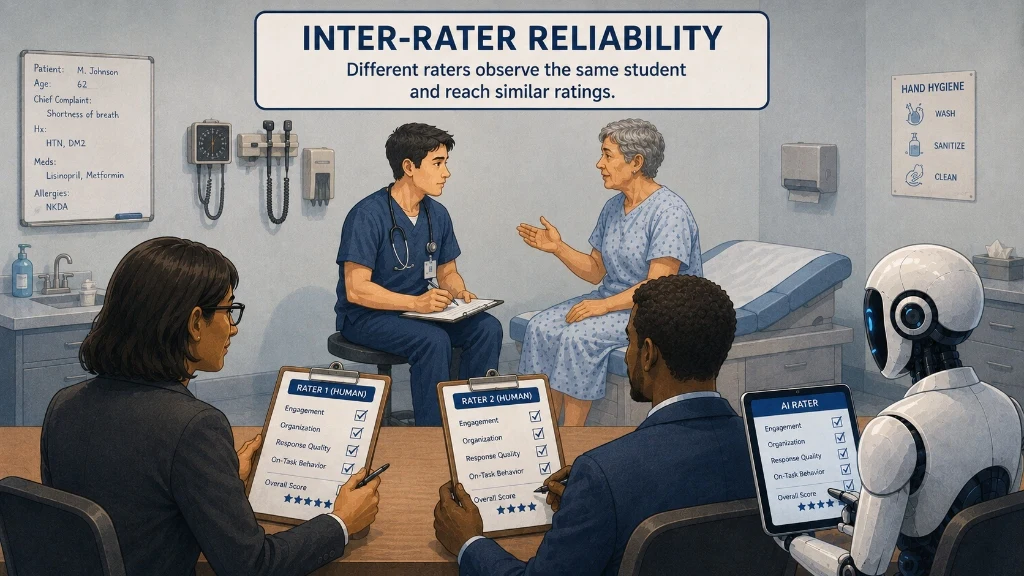
AI, Faculty, and Inter-Rater Reliability Challenges in Healthcare Simulation
Synopsis: Grading clinical performance is inherently interpretive, and inter-rater reliability (IRR) varies depending on assessment format, rater training, and context. Research settings yield excellent IRR but only with sustained investment in faculty calibration that is rarely replicated in routine program operations. AI graders are highly consistent with themselves (intra-rater reliability) but remain imperfectly aligned with human expert judgment. That gap narrows with structured rubrics and prompt calibration. The path forward is not AI replacing human raters, but AI calibrated to human experts; handling volume and consistency while faculty oversight anchors high-stakes decisions.
 Blended Learning & AI
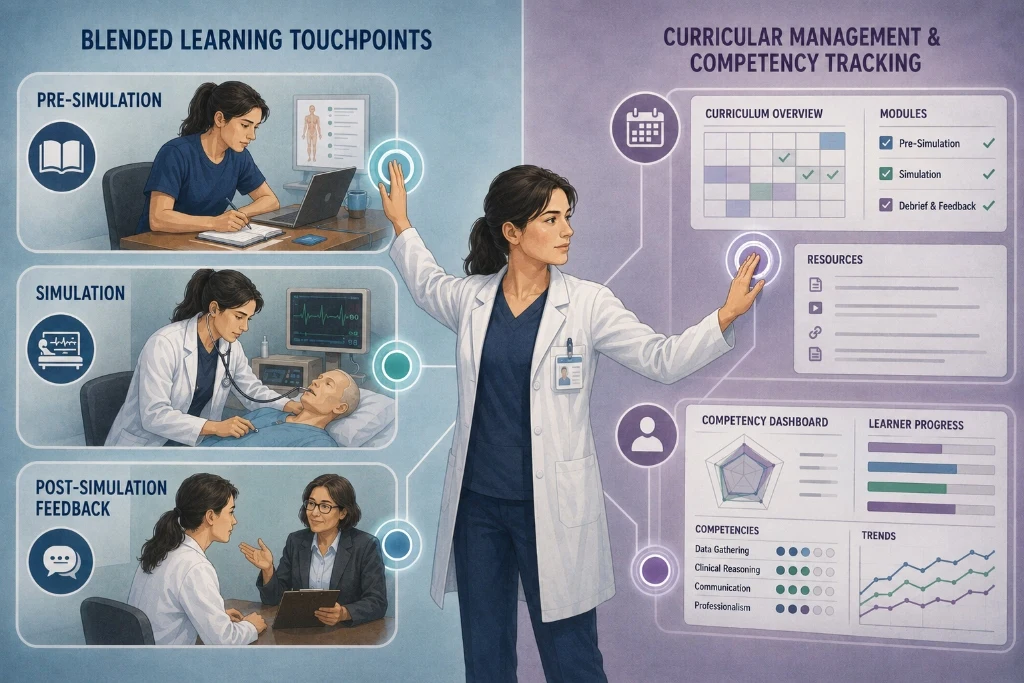
Beyond Hopes and Dreams: AI-enhanced Feedback in Support of Blended Learning
Synopsis: This article examines blended learning in simulation-based health professions education—simulation paired with pre- or post-session learning methods—and argues its payoff depends on feedback. It reviews advantages (spaced repetition, efficient use of costly lab time, learner-paced pre-work) and barriers (faculty and trainee time, need for explicit curricular integration, disconnected simulation and learning management systems). Examples of successful blended learning are shared, though none isolate blending as the cause of learner gains. AI-enhanced, faculty-overseen feedback linked to curriculum and competency tracking will move the field beyond hopes and dreams.